Bring 20x your bet* to the table
Be prepared to lose it all
Leave if you win 20x your bet
*bet = your average bet / hand
Betting $10?...leave when you've won or lost $200.
$15?...$300, $25?...$500, $100?...$2,000
NEVER stay to continue or to recover from a streak
Do this, and the odds are 2 to 1 that you walk away
with a bankroll between +/- 20x your bet
Most likely, you are a recrational player who...
- Is playing for fun
- Knows the game's rules
- Is playing at a popular mainstream casino
- Has some knowledge of "what to do when" (basic strategy)
- Can add two two-digit numbers together in your head
If so, then put everything you've read or heard about blackjack aside and relax. With the advice given at the top of this page, you will...
do just as well at your game as the world's foremost blackjack expert.
Want proof of this, then read on. Want to take bigger chances for bigger rewards, read on. Want to look like you know what you're doing at the table, read on. What follows are easy-to-understand explanations of the game's fine points.
Because...
- Recreational players are focused on the short term, an evening, weekend, or vacation, and don't care about their long-term results.
- Luck is what determines the winner or loser in the short term.
- House edge is not big enough to materially affect the short-term game.
- Basic strategy errors, for most players, are small and infrequent; they have little effect in the short term.
- Statistics let sane players right size their bankrolls and create a sensible exit strategy.
Here's the bottom line...
In the long term (years or decades), experts will do about 1% better than recreational players by finding the best table odds and never making a basic strategy mistake. So, if you play $25 a hand for 10 games a year, the total amount you bet will be about $50,000 ($25 * 50 hands per hour * 4 hours * 10 games), and the amount you will "save" over the recreational player is about $500 a year (1% * $50,000), $5,000 a decade, and about $25,000 after 50 years of play. Of course, the house edge still applies, so even an expert in this example will still "pay" $250 a year to play the game. Card counters can do much better than this with a rate of return of about +1.5% of their total bet. Of course, they must remain undetected for years, which is not easy when you make very large bets in response to the odds turning in your favor.
...Because it causes at least five times more up and down movement in your bankroll than house edge and basic strategy errors combined.
Let's take the standard formula for predicting the win / loss range, to see this with real numbers...
WIN RANGE = LUCK (happenstance) minus COST (house edge and basic strategty errors)
LOSS RANGE = LUCK plus COST, where
LUCK = average BET times square root of HANDS played times standard deviation (SD) for blackjack, and
COST = (house EDGE rate plus player ERROR rate) times TOTAL BET
Let's also define a set of typical values a recreational player will encounter in an evening:
HOURS of play = 4 (an evening)
RATE per hour = 55 (a moderately crowded table)
HANDS = HOURS times RATE = 4 times 56.25 = 225
square root of HANDS = √225 = 15 (see note below)
average BET = $25 (typical for the time of day a recreational player is at a table)
TOTAL BET = BET times HANDS = $25 times 225 = $5,625
SD (standard deviation) for blackjack = 1.14; 2 SD = 2.28; 3 SD = 3.42 (see note below)
house EDGE = 0.43 (assuming table rules commonly found in most casinos)
player ERROR = 1.0% (most experts estimate this is between 0.5% and 1.5%)
Plugging these values into the standard formula we get the following values for LUCK and COST:
LUCK = BET times √HANDS times SD = $25 times 15 times 1,14 = $428
COST = (EDGE plus ERROR) times TOTAL BET = (.0043 plus .01) times $5,625) = $80
The result is that the $428 from luck is 5.35 times larger than the $80 from costs. (This is with one SD -- a 68% probability.) The difference is even larger with higher Standard Deviations (higher proabilities).
By the way, the WIN / LOSS RANGE in this example is +$348 to -$508, meaning that there is a 68% probability (1 SD) that this player will walk away from this table with between $348 in profits and $508 of losses. (Refer to the above formula for the specific calculations.)
But are the values used in the formula realistic? The following notes address this question.
Is 0.43% a realistic expectation for EDGE?
Any significant up or down movement in the EDGE would require casinos to dramatically change their table rules, which would discourage recreational players from playing the game. Most blackjack games stick to the following:
6 decks
Dealer stands on soft 17
Double after split
Double on any first two cards
Resplit to 4 hands
No respliting of aces
No hitting of split aces
No surrender
Blackjack pays 3:2
Is 1.0% a realistic expectation for ERRORS?
Very few players can play a perfect basic strategy game; however, most players know most of basic strategy. What they don't know, typically, are the very close calls like 16-versus-10, and the hard-to-learn exceptions like soft-18. By simulating the play of players making these errors, statisticians have determined that the effect is 0.5% to 1.5% of the TOTAL BET. I've used the 1% median in the calculation.
What is Standard Deviation (SD) all about?
Don't be intimidated by SD (standard deviation). This is simply the amount a blackjack player's bankroll will typically move up and down during a game. It's calculated to be 1.14 "betting units." This is done by having a computer simulate millions of hands of blackjack and noting the results.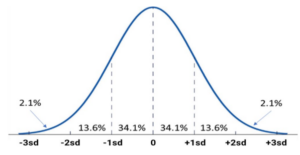 (A betting unit has a value of $1.)
If you plot the observed simulation results of "bankroll amount by number" on a graph, you get a bell-shaped (normal) curve, where 68% of the results are within +/-1 SD of the starting bankroll, which is used as the mean, 95% are within +/-2 SDs, and 98% are within +/- 3 SDs.
To calculate the actual value of one standard deviation on the WIN side use the formula WIN = (average)BET * square root of HANDS(played) * SD(for Blackjack) or WIN = $25 * 15 * 1.14 = $428. (See example above.)
The square root of the hands played
The WIN / LOSS formula uses the square root of the number of hands played because the impact of more hands on the outcome is not linear. For example, playing 225 hands rather than 100 hands does not result in a 125% larger win or loss. Rather, the increase, according to the central limits theorum (which is what gives us the bell-shaped curve, is closer to the square root of the population times the SD. That is, playing 10,000 hands versus 100 hands of blackjack results in a WIN range that is 10 times bigger (100 [the √10,000] versus 10 [the √100]), rather than a range that is 100 times bigger (10,000 versus 100).
The formula for calculating the win / loss range
The formula for calculating the win / loss range with a specific probability simply combines the five factors that influence this result in a logical way. By multiplying the BET amount times the HANDS (adjusted for the central limits effect by taking the square root) times the standard deviation, we are calculating the "normal curve" for blackjack winnings and losses. By subtracting the house EDGE and the basic strategy ERROR, we are adjusting the entire curve by moving it slightly left of the starting bankroll.
Why 225 HANDS?
I'm assuming four hours of play at a moderate rate of 55 hands per hour or 225 hands.
What's the long term effect?
In the long term, the wins and losses will cancel each other out (based on the law of large numbers), leaving with the cummulate effect of EDGE and ERRORS, which could be quite substantial if the recreational player was keeping track of them. But they are not. Most players know intuitively that their wins and losses will even out over time and they consider their costs (EDGE and ERROR) the cost of blackjack entertainment.
By "serious players" most people mean...
Card counters -- those who wait for good odds, bet high, and think the casinos will never notice;
Bean counters -- those who keep track of their P/L over time; and
High rollers -- true gamblers who bet a lot of money and only ever talk about the fortunes they won.
In fact, all of these folks live the fantasy worlds created by Hollywood and Las Vegas, where handsome people with magical skills, fierce determination, and courage beat the casinos. In truth, it's all baloney, no one is getting rich playing blackjack.
The only true winners are recreational players who: play to be entertained, understand they can win real money sometimes, and know that the casino's always win over time. Still, even these level-headed realists have their doubts given all the hype about how a dedicated and determined "knowledge player" can win at blackjack.
I'm not saying this is wrong -- if luck is with you, anyone can win big in the short term -- what I'm saying is that this is highly unlikely over time, that wins and losses even out and what you're left with is the costs. Even a dedicated card counter, who works hard to eek out a minor odds advantage, is unlikely to walk away with much more than he or she could earn at a fast-food restaurant. The law of large numbers, that over the long term everything you've won or lost by luck will approach zero is relentless.
No card counter will ever admit this, of course. To hear them tell it, they use a casino like an ATM. I wonder, though, why they are working so hard to get you to buy what they are selling if they have unlimited access to "free money."
Of course, winning isn't everything. No one ever wants to look like an idiot at the table. Knowing the game's rules, making generally correct decisions during play, and following proper blackjack etiquette is also important. It's just not going to make you a winner, only luck can do that.
It's painfully obvious to anyone who has ever actually played the game that an evening of blackjack play is likely to result in your bankroll going up and down, like this...
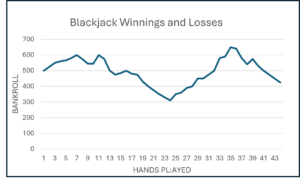
Sure, it's possible that you just win or lose one hand after another, but it's rare. The most likely scenario is that you'll win some and lose some, win some and lose some...
It turns out that the range associated with this "win some and lose some" scenario is pretty narrow. This is because your blackjack profits and losses stay small relative to the size of your bet (unlike a lottery bet for example), and they are evenly distrubuted between profits and losses.
"How small?" is the key question. Statisticians have developed ways to estimate this using the formulas:
WIN / LOSS RANGE = LUCK +/- COST
LUCK = average BET x square root of HANDS played x standard deviation (SD) for blackjack
COST = (house EDGE rate + player ERROR rate) x TOTAL BET
For example, they know there's a 75% probability (3 to 1 odds) that your profit and loss range playing blackjack for an evening will be between -20 and +20 times your bet. So, a player who starts with a $500 bankroll and bets $15 on each hand has a 75% chance of walking away with a bankroll of between $200 and $800, that is, +/- $300 due to luck. Of course, there's still a 25% chance that this player will walk away with a bankroll outside this range.
So, a reasonable exit strategy, that is, a plan for when to walk away might be this "20x / 75% probability" suggestion. It will give you 3 to 1 odds that you won't lose your entire bankroll, and that you won't walk away from a good run of luck too soon.
If you want to take a bigger or smaller chance, you can change the odds. For example, there's a 50% (.05 SDs) chance that this player will walk away with an amount that's equal to his or her bankroll +/-$128, and a 95% (2 SDs) chance that he or she will walk away with his or her bankroll +/-$513.
The answer to this question gets a little wonky even at this basic level and requires a good understanding of standard deviation.
Standard deviation (SD) measures the spread (i.e., the dispersion) of individual "values" around their average (the mean of the population). For example, if the average lottery payout is $10 but this results from averaging "millions of $5 payouts and one or two $5 million payouts," the "spread" (the SD) is huge. On the other hand, it's small when the average "weight for an American male is 200 pounds and more than two-thirds of all men are within +/-40 pounds" of this average.
SD is calculated by taking the distance from the average for each individual value (its variance) and averaging these variances, assuming each event that causes a variance is random and independent of other events, like with blackjack. These values will be evenly spread above and below the average, forming a symmetric (normal) distribution, which allows us to estimate the overall spread of values as a function of the SD's distance from the average.
For blackjack, the "values" we're interested in measuring are the player's profits and losses after each hand. After looking at millions of data points, statisticians have calculated that the SD for blackjack is 1.14. In other words, for blackjack, the spread (the dispersion) of individual bankroll profit and losses (values) around their average (the starting bankroll) is 1.14 SDs.
Knowing this, we can multiply the SD by the number of individual bets and by the bet amount (an average or flat bet amount) to estimate the profit and loss. Since blackjack results are random (evenly distributed between profits and losses), we can also use this results to determine the probability that future profits and losses will fall into the same range.
For example, if we play 240 hands of blackjack at $15 per hand, given the SD of 1.14, we know that 68% (+/-1 SD) of the profits will be within +/-$265 of our starting bankroll (1.14(the SD) x $15(the bet) x 15.5(the square root of 240 hands).
To bring this home, let's restate this result a different way. A player playing a blackjack game for 4 hours long (an evening) with 60 hands played per hour (an average rate) and a constant bet of $15 will have a 68% chance (one standard deviation) of winning or losing $265, which is almost 18 times his average bet of $15. I've increased the probability a little (to about a 75%) and rounded it off to get my easy-to-remember-and-calculate 20x recommendation for when to quit.
The formula uses the square root of the number of hands played because the impact of more hands on the outcome is not linear. Rather, the increase, according to the central limits theorum, which predicts a bell-shaped curve given a large enough population, is closer to the square root of the population times the SD. That is, playing 225 hands versus 100 causes a 50% increase in outcomes -- 10 versus 15.
I told you it was going to be wonky. To anyone who understands standard deviation, however, this explanation is laughably trivial, to anyone who doesn't, just accept it, like we do for most scientific outcomes.
I've played a million hands of blackjack -- at least it seems that way -- and I've yet to find a perfect basic-strategy player. Perhaps this is because I play at the "low roller" tables, but even so, the perfect player should not be this hard to find.
The reason he or she is so rare I believe is that most recreaational players are not obsessed with playing an absolutely perfect game. They know 80%, or 90%, or 95%, or 99% of basic strategy and wing it for the rest, which results in the 1% player error estimated in the calculations. This leads to the obvious conclusion that players should learn the rules that make a difference and not worry about the rare exceptions. Armed with this pragmatic view, I have a few suggestions.
Learn these 14 easy rules:
- If you have a hard hand (no aces or pairs) and...
- 8 points or less...HIT
- 9 points and facing a 3,4,5, or 6...DOUBLE; otherwise...HIT
- 10 or 11 points and facing an ace...HIT; otherwise...DOUBLE
- 12-16 points if facing 6 or less...HIT
- 12-16 points when facing 7 or more...STAND
- 17 points or more...STAND
- If you have a soft hand (ace = 11) and...
- 13 (Ace+2) -16 (Ace+5) and face 2-3 or 7-A...HIT; otherwise...DOUBLE
- 17 (Ace+6) -18 (Ace+7) and facing 6 or less...DOUBLE; otherwise...HIT
- 19 (Ace+8) - 21 (Ace+10)...STAND
- If you have a pair of...
- 2s, 3s, 6s, 7s, 9s and facing 7 or less...SPLIT; otherwise...HIT
- 4s and facing 4, 5, 6...SPLIT; otherwise...HIT
- 5s...treat as hard hand
- 8s and Aces...SPLIT
- 10s...STAND
The MOST important thing is to DOUBLE and SPLIT when it's recommended. This is because the player has the odds advantage at these times and is allowed to multiply his or her bet. It's these rare opportunities that cause blackjack to be nearly a 50-50 game for the player.
If you forget a rule, THINK. It's often easy to make the right choice by simply adding the values, thinking about the possibilities associated with each decision, and estimating the risk-return in your head.
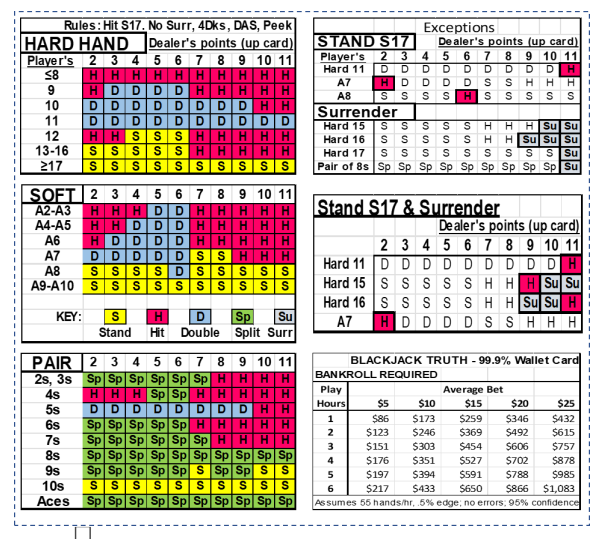
Once you're comfortable with the 14 easy rules, learn the hard-to-remember exceptions by memorizing the basic strategy chart.
Here's a basic strategy card with exceptions...
Rules of the Game
What follows are the rules for the American, multi-deck, blackjack game, which is common everywhere but in Europe, including ships at sea.
[The rules for the European game are different. In the European game, the dealer gets one up card at the beginning of play and a second card only after all players have completed their play. This changes the dynamics of the player’s game with respect to blackjack, even money, insurance, peeking, and surrender.]
In Summary
Blackjack is a card game between a player and a dealer, who represents the casino. Players do not compete against each another, instead they make individual decisions to bet and to hit, stand, double, split, or surrender depending on the cards they can see. The dealer can only hit or stand in accordance with the table’s rules (e.g. sometimes the dealer must stand on soft 17).
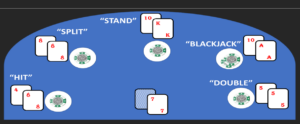 In the American game, the dealer gives each player two cards, both face-up, and gives himself one card face-up (the up card) and one card face-down (the hole card) as illustrated below.
The player must have more points in his hand than the dealer without exceeding 21 points to win. When he wins the player takes back his bet and receives one like chip for every chip he has bet.
Points are determined by the card’s rank as shown below.
Aces = 1 or 11 points (at the player’s choice)
Picture cards and tens = 10 points
All other cards = the card’s face value (2, 3, 4…)
Player earn points by choosing to:
Keep the first two cards (stand)
Get another card (hit)
Double the bet (double)
Separate the pair into two hands (split), or
Give up the hand (surrender)
If the player has blackjack (21 points in his first two cards), the dealer immediately pays him three chips for every two he or she has bet, or some other premium ratio like six chips for every five, depending on the table’s rules.
After each player has made his decision to stand, hit, double, split, or surrender, the dealer turns over his hole card and either hits or stands depending on his cards. Typically, the dealer stands if he has 17 points or more and hits if he has 16 points or less. If a player or the dealer hits and his resulting point total is more than 21 points, he loses (busts). If the dealer busts, all players who have not busted win.
If the player has blackjack and the dealer’s up card is an ace, the dealer will offer the player “even money” -- a one-for-one (1:1) payoff rather than the 3:2 or 6:5 payoff normal for blackjack.
If the player does not have blackjack and the dealer up card is an ace, the dealer will offer the player “insurance.” The insurance bet, which is up to one-half of his original bet, pays 2:1. This allows the player to break even if he loses his original bet to a dealer’s blackjack.
In Detail
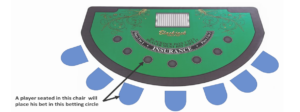 Let’s go over this process again in more detail.
To join the blackjack game, the player takes an empty seat at the table.
To get chips, the player puts his cash on the table on the player’s side of the betting circle. The dealer will exchange his cash for chips of an appropriate denomination as soon as play allows.
The chips used for betting are usually a standard color that designates their value:
White = $1 Pink = $250
Red = $5 Purple = $500
Green = $25 Yellow = $1,000
Orange = $50 Lt. Blue = $2,000
Black = $100 Brown = $5,000
Every blackjack table has a sign or imprint on the table’s felt that gives the table’s…
Minimum Bet The lowest bet amount permitted
Maximum Bet The highest original-bet amount permitted
Blackjack Payoff The payoff for blackjack (e.g., 3:2, 6:5)
Hit/Stand Rule When the dealer must hit
(Usually, the dealer hits with 16 or less and with soft-17, an ace and a 6.)
In more formal settings, a player should wait for the cards in the “shoe” to finish or ask the other players if they object to him joining the game mid-shoe. Most of the time, the other players will welcome a new player. (The shoe is the long box that holds multiple decks of cards for the dealer; so called because it resembles a woman's high-heel shoe.)
The player places his bet inside the betting circle before the dealer starts to deal the hand.
The object of the game is to beat the dealer. This is done by having more points than the dealer without going over 21 points and busting.
[The object is not to get 21 points, to get close to 21 points, or to avoid busting, it is to beat the dealer. Many players, even experienced ones, reduce their chance of winning by chasing the 21-point target when it’s not necessary to win.]
The dealer takes the first card from the new shoe -- sometimes showing it to the players, sometimes not -- and places (burns) it in the discard tray. [This tradition is followed to prevent “steering” which occurs when the dealer cheats and deals an illegal card from the top of the shoe.]
The dealer then deals the next card in the shoe to the first player on his left and continues around the table from his left to his right giving each player and himself a card until everyone has two cards. [Casinos teach dealers to deal cards to the chips in the betting circle rather than to the players sitting at the table. This prevents the dealer from accidentally dealing cards to a player who has forgotten to place his bet or who wants to sit out a hand.]
Preliminary Play for Blackjack, Insurance, and Even Money
When the initial deal is finished, the dealer assesses all the hands at the table and completes several actions depending on the cards.
- The dealer pays any player with blackjack the blackjack payoff (3:2 or 6:5) if his up card is not an ace.
- If the dealer’s up card is an ace, he offers any player with blackjack even money (a 1-for-1 payoff) and immediately pays those who accept.
- The dealer offers insurance to any player who does not have blackjack if his up card is an ace.
Any player who wants insurance places as much as one-half of his original bet on the table’s insurance line.
Once these transactions are finished, if the dealer’s up card is an ace or a 10-point card, the dealer looks at (peeks) at his hole card to check for blackjack.
- If the dealer’s hole card is a 10-point card and he does have blackjack,
- He pushes back the original bet of any player who has blackjack and who refused even money
- He pays $2 for every $1 for the insurance bets on the table’s insurance line
- He takes the original bet of the other players
- Play ends
- If the dealer’s hole card is not a 10-point cards (no blackjack),
- He announces that he does not have blackjack
- He takes all insurance bets
- He pays the blackjack payoff (3:2 or 6:5) to any player who has blackjack and had declined even money
For those who prefer pictures to words, this process for dealing with blackjack, peeking, even money, and insurance (what we have called “Preliminary Play”) is repeated in the two flow charts that follow.
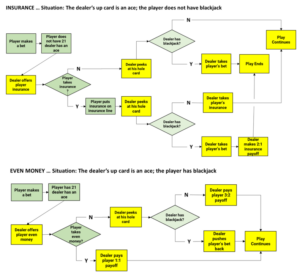
There are no standard hand signals to accept or reject even money or insurance. Most players just nod or shake their heads and, sometimes, confirm their choice with a verbal yes or no.
The dealer will always ask each player with blackjack if he wants even money. The dealer will always announce that “insurance is open” and, after a few seconds, “insurance is closed” to the table at large.
[Many players don’t know these rules for peeking, insurance, and even money and they don’t care. They simply follow the dealer’s lead and make the choices that seem appropriate during the preliminary play process.]
This is the end of “Preliminary Play” and the start of “Mainstream Play.”
Mainstream Play
Once all the blackjack, insurance, and even money transactions are finished, the dealer asks the player on his far left what he wants to do -- stand, hit, double, split, or surrender. The player makes his decision based on the point value of his hand and the dealer’s up card, hopefully using the basic strategy recommendations. The following paragraphs describe these five player decisions.
STAND… “I don’t want any more cards.”
Signal The player waves his flat hand horizontally over his cards.
Dealer’s Action The dealer moves to the next player.
Comment It is often hard for the dealer to discern the stand signal from the hit signal, which can lead to major problems like the dealer dealing the next card to the next player when the current player wanted a hit. To avoid this, dealers will often confirm the player’s decision when the player’s hand signal is unclear or when the player’s decision is unusual, but not always. Be sure to signal clearly.
HIT… “I want another card.”
Signal The player points at his cards or taps the table.
Dealer’s Action The dealer gives the player another face-up card then ask for the next choice if the player is under 21 points. A player can continue to hit until he makes the decision to stand, or until he busts.
Comment If a player hits and busts, the dealer takes the player’s bet, puts his chips in his chip tray, takes the player’s cards, and puts them in the discard (burn) pile.
DOUBLE… “I want to double my bet and get one more card.”
Signal The player places chips equal to his original bet or less (called double-for-less) just behind his first bet and holds up one finger, indicating he wants one more card.
Dealer’s Action The dealer deals the player one card. If the card causes the player to bust, he loses both his original bet and his double bet. After dealing the one card, the dealer moves to the next player.
Comment Some table rules allow players to double only when the player’s hand has a specific point value (e.g., 10 or 11), most, however, have no restriction on doubling.
SPLIT… “I want to split this pair and place another equal bet on the new hand.”
Signal The player places a bet equal to his original bet beside his original bet and holds up two fingers indicating that he wants two cards, one for each new hand.
Dealer’s Action The dealer separates the player’s two cards and his two bets to create two new hands; he then deals a card to the first new hand and asks the player for his decision on this hand. The player has all the same options he has with any initial hand (hit, stand, double, split, or surrender). If the player’s decision causes him to bust, he loses his bet for this hand. The dealer moves to his second hand of the split pair once the player has finished. If the player receives another pair on any split hand, he may split again and the process repeats.
Comment A pair is two cards of the same rank (e.g., two eights) and at most casinos, any two 10-point cards (e.g., a ten and a jack). Usually, table rules limit a player to splitting three times for a total of four hands and four bets. Players can hit, stand, double, re-split, or surrender for each new hand except when the original pair is aces. If a player splits aces, the dealer will deal him one and only one card for each split ace. Table rules do not typically allow re-splitting aces nor do table rules allow the premium blackjack payoff of 3:2 or 6:5 on 21 points after splitting aces.
SURRENDER… “I want to stop playing and surrender half of my original bet.”
Signal: The player says “surrender” and/or runs his hand in a straight line behind and perpendicular to his cards.
Dealer’s Action: The dealer takes the player’s cards, removes half of the player’s original bet, and pushes back the other half.
Comment: Surrender comes in two flavors -- early and late. Early surrender happens before the dealer checks for blackjack by peeking. This is rare nowadays, which is why early surrender is not included with the description of even money, insurance, and peeking. Late surrender, which happens after the dealer peeks at his hole card and announces that he does or does not have blackjack, is also rare but much more likely than its early-surrender cousin. Casinos do not typically allow early or late surrender at low-minimum blackjack tables.
Once the first player has finished, the play moves on to the next player and the process repeats.
When the last player has finished, the dealer turns over his hole card and either hits or stands depending on the table’s rules. If he hits and busts, all the players who have not busted win.
The dealer pays any player who is closer to 21 than he one like chip for every chip in the player’s original bet, leaving both the payoff and the player’s original bet in the betting circle for the player to collect. The dealer returns, without any payoff, any player’s original bet where the player’s and dealer’s points are equal (a tie, called a push). The dealer takes the bets of those players who have fewer points than he does.
The dealer adds all the cards played to the discard tray (the burn pile) and the play continues until the dealer reaches the cut-card (a plastic marker the same size as the cards) in the shoe. He continues to deal this final hand to the remaining players then he shuffles the cards.
In some casinos, the dealer puts the cards in the discard tray to the ASM (Automatic Shuffling Machine). Other casinos use CSMs (Continuous Shuffling Machines), where the dealer continuously adds cards to the shuffling machine which is continuously shuffling.
To leave the game, the player pushes his chips forward and waits for the dealer to exchange his chips for higher denominations chips (called color up or coloring up). The player can hold these chips for later or redeem them for cash at the cashier window.
Giving subjective advice is always a risky proposition. However, much of the information available to recreational players about blackjack is poppycock -- wrong, misleading, or nonsense cloaked in technical gobbledygook. The player needs to sort through this and decide which makes sense. Here’s my list.
Etiquette
Don’t touch anything on the table...
Except your own chips! And touch those only to make a new bet; or to collect your winnings after the dealer has made the payoff. The dealer will handle the cards and collect all bets himself.
Use clear, easy-to-understand hand signals...
And if you like, confirm your intention verbally. The security cameras watching the table need to record the player’s hand signal. This is critical if there's a dispute. Sloppy signaling is the most common reason for arguments about the player's intention. Take the time to signal correctly.
When you are ready to play, just put your money on the table
There’s no need to throw your money across the table or wave it back and forth. The dealer knows you are here to play, and he will get you into the game as soon as possible.
When you want to leave, push your chips forward slightly and wait
The dealer will change your small denomination chips to larger ones (color up) as soon as he has an opportunity. Take these to the cashier's window to exchange them for cash or hold them for later play. Don’t try to leave the table with a pocket full of small-value chips as this could deplete the table of needed chips. Don’t try to help the dealer by stacking the chips; the dealer needs to do this for the overhead cameras.
Sometimes, by accident, a player who wants to leave pushes his/her chips onto the betting circle. If the dealer mistakes the player’s intention, he might deal the player a card. If you then proclaim your intention was to leave, it’s a dispute.
Don’t give unsolicited advice, comments, or criticism…
Of someone's play unless he asks you for it. Making another player feel like a fool is not appropriate even if he is playing like one. This holds true even when his sloppy or erroneous decisions affect the outcome of a deal. His mistakes will work in your favor as often as they work against you.
Don’t criticize the third baseman
Many people like to complain about the decisions of the player immediately to the dealer’s right -- third base -- because his play can result in the dealer getting good cards. This is not sensible; no one knows what cards are coming next and there is no way this player or any other can change the random outcome of the game.
[The reason the third baseman gets such a bad rap is that it’s easier for some players to accept a loss when the dealer gets his cards from the blackjack gods rather than because of the third baseman’s decisions.]
Take all advice, even from the dealer, with a grain of salt
Strangely, most of the advice given at a blackjack table is wrong. Many players and dealers rely on blackjack lore and entrenched beliefs like “never refuse even money.” The best way to deal with well-intentioned advice is to smile and play your own game. Having an intelligent debate at a blackjack table while play is underway is problematic.
Don’t shout, scream, swear, or otherwise carry on when you win or lose
This is disrespectful of the other players. Reasonable players are usually conservative, saving their enthusiasm for those few times of real happiness or disappointment.
Don’t spill your food or drink on the table
No one will ask you to wear a dunce cap with “moron” printed on it if you spill your food or drink, but they might as well because you’ll feel like one.
Don’t distract the other players
The players in most games are naturally friendly towards each other and talk. This is fine until it interferes with play. If a player is trying to follow the game closely or needs quiet to remember the right basic strategy play, then stifle yourself. Imagine the blackjack table is a putting green.
Don’t make jokes about card counting or cheating at a blackjack table
This will bring you to the immediate attention of the pit boss and once again label you as either a card counter, a cheat, or a nincompoop. If you then do something suspicious, even if it’s innocent, management will be all over you. Casinos are almost as sensitive about card counters and cheaters as airlines are about bombers.
Don’t flaunt your success or bemoan your losses
No one cares. This also applies to players who are constantly counting their chips.
Pay attention to the game
Don’t delay the game by talking to someone who’s not playing, by watching the TV monitors, or by being diverted in some other way. The dealer will usually say something after a while, but why make this necessary? Even worse, some players are oblivious to the dealer’s admonition, potentially sparking table rage from the other players.
[This is one of the most annoying and disrespectful table behaviors and it happens often! Why should the rest of the players at the table have to wait for you?]
Play multiple positions only when plenty of seats are available
Some players believe (wrongly) that they have a better chance of winning by using adjacent betting circles to play multiple hands at the table. If other players are waiting for seats, the right thing to do is stop playing these multiple hands and allow other players to join. Sometimes, a player who thinks he is having a run of luck will refuse to stop playing an extra position even when requested by the dealer.
[This is another of those especially boorish behaviors that annoy other players. There is no difference in the odds between playing two positions and doubling your bet on one position. If you think it is your right to play multiple positions because you got there first or because you are betting more than other players, then you are, by definition, an ass.]
Respect the local conventions
When in Rome… Sometimes there are local rules or conventions. Don’t buck these just because it’s done differently somewhere else. For example, in most venues, players put a split bet beside their first bet, and they put a double bet behind their first bet. Some players ignore these local conventions as if insulted that they need to change their personal style of play.
Tip if you want, but don’t make a spectacle out of it
There are three ways to tip the dealer -- after a hand, when you leave the table, or by placing a second bet for the dealer on the edge of the betting circle. Whatever your preference, do it in a low-key way. Making a big show of tipping is boorish again. Tipping is optional and there is no traditional or expected amount or percentage.
[Placing a second bet for the dealer slows the game for the other players. Players do it out of the superstition that the universe will reward their generosity with a winning hand. Most blackjack dealers won’t say anything, but common sense says that they prefer to make their own gambling decisions. Would you want your boss to flip a coin with you for your paycheck? If you want to give the dealer a tip, just give it and let him decide if he wants to gamble with it.]
Misconceptions
There are “professional” blackjack players who make lots of money
The longer you play, the more likely it is that your profits and losses will break even, and the closer you will come to what you are “expected to lose.” This applies to pros and duffers alike, only a card-counter or a cheat can beat the odds.
There are blackjack and betting "systems" that work
No one except a card-counter or a cheat can win at blackjack in the long run. Period, end of story! No fancy betting scheme, playing trick, mojo-enhancer, streak-following methodology, exit plan, standard-deviation computation, statistical analysis, where-to-sit advice, when-to-play suggestion is going to change the fact that the rules of the game always favor the house and that “in the long run” the house will always win.
[Of course, “the long run” can be tricky to predict. Even though the odds are against it, a decent player can win big for an evening, a year, or even for a lifetime. It’s all about luck and how close you can get the house edge and if you can reduce the basic strategy skills handicap to zero.]
Card-counting is simple, easy, exciting, and lucrative
Card counting is not illegal, but it’s not for the recreational blackjack player. Yes, you can win, but forget what you’ve seen in the movies; this is not your glamorous and lucrative “Bat Masterson moment.” It’s hard work, boring, and stressful. Also understand that the winnings come at a glacially slow pace; and that eventually, someone will catch you.
If luck is with you, you can win a fortune with a tiny bankroll
Sure, it’s possible to turn a small stake into a fortune, but blackjack is a game of patience with moderate risk and moderate returns. It is not like the lottery where players can win great fortunes by investing a dollar or two. We have all heard stories of someone saving his business by running a $5,000 bankroll up to a million. The reality, however, is that most of what you win at blackjack is a function of luck adjusted in the long term by the house edge, your skill, and the amount you bet, which is why it's hard to run a tiny bankroll into a great fortune.
A careful player can stretch out a small bankroll to last a long time
An adequate starting bankroll is necessary to avoid going broke prematurely.
Players can change their luck by disrupting the flow of things
Wrong. There is no difference between playing 10 separate blackjack sessions with a $500 bankroll and one session with a $5,000 bankroll. There's no difference between playing one hand at a time and playing multiple hands. There is no advantage in jumping from one table to another, in varying your bet, in taking a break, in moving chips between partners, in chasing a winning streak, or hiding from a losing one. The odds of winning and losing are the same.
Some players can predict what the next card is going to be
For all practical purposes, the cards come in a completely random order and all blackjack hands are independent of all other hands. Accordingly, no one except a card counter or a cheat can predict what the next card will be in blackjack.
Luck runs in streaks, when a streak comes along, bet the farm
Let's be honest, very few of us are ready to accept the full truth of random events. If a coin toss comes up heads 100 times in a row, we "just know" that the next toss is going to be tails. It's in our DNA to believe in a cosmic balance. Unfortunately, this is just not the way the universe works. Streaks start and end in a random and unpredictable way. If you ignore this, you will lose.
Casinos expect some friendly cheating and are tolerant of it
If you think the casino will excuse your cheating, you’re sadly mistaken. Don't do it especially in a foreign country. Counting cards in your head isn’t illegal, but there are lots of other schemes that are. If you practice them, you will end up in the clink.
In the end, all casino games are the same
Not true. Blackjack gives you the best chance of winning of any casino game. A house edge of 0.5% is the best you are going to find anywhere in the casino. The absolute genius of blackjack is that it allows players to lose slowly and win suddenly.
The effect of bad table rules or not knowing how to play is small
The effects of bad table rules and inadequate basic strategy skill is not as great as luck, but they can devastate a player’s long-term game. Additionally, luck is going to turn eventually. What’s lost due to bad table rules and inadequate basic strategy skill is gone forever.
Blackjack is a boring game fit only for experts
Blackjack is fun for everyone! The casino lights, the card play, the free drinks, the interesting people, the shared excitement of winning and losing -- it can be exciting especially if you are winning!
Good Advice
Learn basic strategy
Playing the odds is the only way to succeed over the long term. Basic strategy is the starting point for any player determined to win, or at least determined to survive a few hours of play. Most recreational players can learn enough basic strategy in an hour or two and reduce their handicap to a reasonable 1 or 2% of the bet total.
Have a gameplan
As with any game of skill and knowledge, you will have an advantage if you prepare for your blackjack play. Your plan doesn’t need to be elaborate or even written down. It simply needs to bring together what you know about the game and the particulars of the table you’ve targeted. Knowing when you’re going to play, for how long, and your average bet are important elements of any gameplan.
Gather intelligence
Find out the table minimum and the table rules for the blackjack game you want to play. A player can do this by casually strolling through the casino and reading the printing on the tabletop, reading the table’s placards and signs, observing play for a few minutes, or by talking to an idle dealer.
You also can estimate your skills handicap by testing yourself with an online game without using the basic strategy charts. Be honest, a skills handicap can easily exceed the house edge.
Calculate your required bankroll and your profit goal
Use the Rule of 33 (33 times your average bet) to calculate the amount you need to bring to the table. (This is more aggressive than using 20x your average bet as losing 33x your average bet will turn off most players.) Use the Rule of 33 to calculate your profit goal and leave the table when this is reached…if you have the discipline.
Refresh your knowledge of the basic strategy decisions
Refresh you knowledge of basic strategy before each game. There won’t be time to ruminate at the tables. Print out a copy of the basic strategy decisions for the table rules you will be playing with and study it until you have committed it to memory. Then have someone test you. Unless you have a photographic memory, this refresher is necessary to avoid costly mistakes.
Prepare yourself physically and mentally for the contest
If you are tired or you have been drinking or something is bothering you, don’t play. Throwing away your money is not going to help.
Be ready for ups and downs
No one sits down at a table and just wins or just loses. Your pile of chips is always going up and down in an irregular and unpredictable way. If you make decisions based on the size of your bankroll, either in the long-term or the short-term, you will lose.
[Trust the numbers, not your emotions. It’s natural for players to act one way when they are winning and elated, and to act differently when they are losing and depressed. Successfully fighting this instinct is what separates winners from losers.]
Rely on your exit strategy
Calculating a game plan, especially an exit strategy, is the easy part, sticking with it is what's hard. How many of us will have the discipline to walk away when we're winning? It's all about perspective. The player with a moderate bankroll would be ecstatic to double his money before starting to play. Once the winnings are in his pockets, however, his mind replaces that sensible thought with one that screams, "I CAN’T LOSE!" A good quantitative analysis takes the emotion and relativism out of the equation.
Forget rain-dance play
Betting in streaks, randomly increasing or decreasing your bet, playing multiple hands, hopping from table to table, taking frequent breaks, and many other examples of rain-dance play have absolutely no impact on the outcome of your game. What these shenanigans can do is disrupt your calculations, derail your carefully laid game plans, and screw with your head. Once this happens, you're at the mercy of the cards.
Forget about being responsible
Playing to "responsible limits" takes away your statistical advantage. Most people come to the casino with a certain amount of money that they've earmarked for gambling. They are disappointed if they lose it, but also feel comforted by their mature behavior in setting a responsible and affordable mad-money limit. Such smugness is irrational -- the odds don't care how responsible a person you are. Setting aside too little for a bankroll is just another way to make a generous contribution to the casino. Stick with the calculated game plan and don't let your personal values, good or bad, get in the way.
Don't change the rules halfway through the game
You can't fool the numbers by hiding your winnings. Gamblers have lots of strange habits, like pocketing winnings for "safekeeping" midway through a gambling session. Not only is this unlikely to work as a psychological crutch, but it also ignores the fact that your bankroll is going to move up and down during a session. If you really do not intend to re-bet your pocketed winnings, then recalculate a new playing strategy after you have secured what you do not intend to bet.
Pay attention to the game
Distracted players make lots of mistakes. That's real money you're playing with. Allowing yourself to be distracted during a game can lead to big mistakes and greatly reduce your chances of having a winning session. The same goes for alcohol, drugs, and any other influences that can reduce your ability to think clearly and make good judgments.
Decide on your betting strategy
You need to decide what kind of bettor you want to be. Some people bet flat, that is, the same amount each time. This is somewhat boring, but it allows the player to have an accurate estimate of the average bet. Other players bet random amounts, which makes managing your play more difficult.
Another thing to remember about changing the size of your bet is that the casino's security guys are always watching. Card-counters win by increasing the size of their bet when the cards are in their favor. This is one of the clues used by the casino to ferret them out. If you decide to suddenly increase your bet on a hunch, you too can look like a card counter especially if by some miracle, you keep winning. Do this too often and the management will ask you to leave.
Loosen up and have fun
Players who are too intense can make big mistakes.
If you're properly prepared, you will win half as many sessions as you lose over the long run -- guaranteed! Sometimes the wins will be big and that makes the experience fun and hugely exciting. This is the reason you're playing the game, remember?
 Ann Landers said, "At age 20, we worry about what others think of us. At age 40, we don't care what they think of us. At age 60, we discover they haven't been thinking of us at all." I would add that at age 80, we're just happy that we can have concerns about any of this.