
For many of us, health insurance and health care in the U.S. are mysteries. This is made worse by confusing insurance terminology that seems designed to keep us in the dark. This article may help.
What is Medicare, aka Original Medicare Parts A and B?
It’s a federal health insurance program that may cover Americans age 65 or older, those under 65 with disabilities, and those with ALS or end-stage renal disease. Part A addresses hospital care, and Part B addresses up to 80% of doctors’ services and other medical care.
The biggest concerns about Original Medicare are that it:
- Provides little coverage for most nursing-home care
- Doesn't cover routine dental, vision, and hearing needs
- Has high deductibles, coinsurance, and Part B premiums
- Has complicated enrollment, claims, and appeals processes
- Is only funded for the short term
- Is hard to coordinate with Medicare
Click on the following link for a summary of Medicare costs.
Medicare Costs (Part A and Part B)
If you qualify, one strategy is to buy only Original Medicare and pay privately for what it doesn't cover.
What is Medicare Supplement Insurance, aka Medigap?
It's additional private insurance for those enrolled in Original Medicare that may cover the gaps left by Original Medicare. There are 10 types of Medigap plans: A-D, F, G, and K-N. They differ in cost, coverage, and restrictions. Click the following links for summaries.
- Your Original Medicare costs, including your monthly Medicare Part B premium
- Your Medigap monthly premium, which goes directly to the private insurance company
- Any other coverage, such as a prescription drug plan under Medicare Part D
Medigap coverage is for those who want more comprehensive coverage and are willing to pay a premium.
What is Medicare Advantage (Part C)?
It’s a Medicare-approved private alternative to Original Medicare that may cover the same benefits as Original Medicare and Medigap, plus other care such as drugs, dental, and vision. Typically, Medicare Advantage plans cost less than Medicare plus Medigap for the same coverage; however, there are also concerns, such as:
- Improper payments and overbilling
- Limited HMO and PPO network providers
- Strict prior-authorization requirements
- Fewer plans in rural areas
- Cutbacks in coverage
- Higher out-of-pocket costs
- More HMO and PPO network restrictions
What is a Part D prescription drug plan (PDP)?
It's a private prescription drug insurance approved under Medicare Part D that may cover prescription drugs for hospital and outpatient care. It is offered through Medicare-approved private insurance companies and can be purchased as a standalone plan if you have Original Medicare or bundled with a Medicare Advantage Plan.
The following diagram illustrates how it works, and the following paragraph describes it.
The approved insurance company determines its "Formulary," that is, the drugs it will cover, organized into "Tiers." Tiers group covered drugs by price, primarily based on cost, but can also be linked to other factors, such as availability or regulation. The plan also includes an annual deductible ($675 in 2026) that the participant must pay to qualify for the plan's benefits, and a spending cap ($2,100 in 2026), beyond which the plan pays 100%. The plan also identifies a Pharmacy that handles drug administration and delivery. Pharmacies can be online, like Express Scripts, or a physical store, like CVS.
If the beneficiary has selected a Medicare Advantage plan, then the Medicare Plan D that applies to the beneficiary can be bundled with it.
What is Medicaid?
It's a health care program jointly run by the federal and state governments for those eligible based on income and other circumstances. Coverage varies by state up to a maximum payment limit.
The biggest concerns about Medicaid are:
- Differences in eligibility, benefits, and payment rates among states
- Decreases in provider participation due to low rates
- Hurdles created by budget limits and administrative rules
- The ability of the poor, the disabled, and children to navigate the system
- Rising costs of long-term care, such as nursing homes
- Poor coordination with Medicaid
- The disproportionate and enormous spending on those who qualify
What is the Affordable Care Act (ACA), aka Obamacare?
It's a federal law that created insurance marketplaces and expanded Medicaid in participating states.
What are the other options for health insurance?
Americans may get coverage through an ACA exchange, an employer, a union, military or veterans’ health programs, or a private insurance company.
What do the uninsured do?
They pay their own medical expenses, apply for financial assistance, or seek emergency screening and stabilizing care, which hospital emergency departments must provide regardless of insurance.
This summary doesn't even skim the surface, but in trading off precision for simplicity, it hopefully creates the framework on which additional information can be hung.
Many Americans view President Trump and his presidency "unfavorably": his policies are in chaos, his job performance is spotty, his behavior at times is blatantly deceitful, corrupt, and arrogant, and he barely hides his preference for dictatorial rule. So why are his millions of followers still so enthusiastic? You would think they would at least have doubts.
Obviously, they like him. He can be entertaining, even inspiring; his policies often have a veneer of common sense or folksy wisdom; and his logic, at least on the surface, seems irrefutable.
Still, these are just words and abstract ideas; none of them explain the emotional bond between him and his base. The only thing that does explain it is his appeal to American patriotism, family values, and sacrifice. These stir strong feelings that can easily lead to social exclusion and bigotry.
(Germans didn't hate Jews, for example; in fact, they welcomed them into their inclusive society. It was only when Hitler managed to sell them his extreme ideas of Aryan superiority, unquestionable loyalty to the Fatherland, and blame that ordinary people began to see Jews as outsiders.)
Want some examples of Trump doing the same thing? Consider these:
Racism: Trump's opinion of nonwhite Americans and immigrants:
- Trump refers to El Salvador and Haiti as “shithole” countries [1].
- He calls Mexican migrants “rapists” [2].
- He claims migrants bring diseases and destruction [3].
- His advisor Stephen Miller says, “America is for Americans and Americans only” [4].
- His one-time chief media advocate Tucker Carlson says, “Puerto Rico is 75% white,” to explain why Trump would never slow aid after Hurricane Maria [5].
Religious intolerance: The criticism of Muslims and the favoritism shown to Christians:
- Trump set up a DOJ task force to find and end “discrimination against Christians,” even though journalists and many independent experts found little evidence that it was widespread or systematic [6].
- He instituted a Muslim travel ban [7].
Economic elitism: The idea that poor people are slackers looking for a handout from the middle and upper class is a recurring theme:
- Trump has implied that “daycare, Medicare, Medicaid, and other things” are “little scams” [8].
- He has raised eligibility requirements for government programs, which may limit benefits for people facing childcare or transportation barriers [9].
Bigotry is a useful tool for keeping supporters loyal.
Sure, we all have biases, but when a crowd echoes and amplifies them, and a forceful speaker encourages them, they can become a powerful force, even a political platform. Of course, it's unfair to call all Trump supporters bigots, but doesn’t the clear pattern of hate speech and prejudice allow us to say this is the theme, at least in part? Is it really going too far to say that many Trump supporters hold the view that nonwhite, non-Christian, impoverished newcomers are crowding out “real” Americans?
Maybe, but let’s not get hung up on how true this is or on the moral issue it poses. The most important question these exclusionary and potentially supremacist policies present is—does this make sense for America?
I don't think so; let me give just a few examples of why it doesn't
- Diversity and inclusivity have driven our prosperity since the founding.
- America’s infrastructure—railroads, roads, dams, cities—would not exist without low-cost immigrant labor.
- Civil rights have created the stability that has allowed manufacturing and commerce to flourish.
- The H-1B visa program and the skilled programmers and designers it brought to our country have contributed enormously to our world-class technology.
- The fairness afforded by American law attracts foreign investment and keeps domestic savings in America.
Without the melting pot, our continued success would be at great risk as ideas become stale, the population ages and loses productivity, and low-cost workers become scarce, driving up prices. All this will make American exports more expensive and less competitive globally, making us increasingly irrelevant on the world stage.
Maybe bigotry is a persistent part of our diverse American culture, but exclusion has never worked as a popular theme or as national policy, and it will not work now.
Notes:
[1] AP News, January 2018, at the White House
[2] ABC News, 6/16/2015, at Trump Tower
[3] The Guardian, July 2025, in a presidential campaign speech
[4] Forbes on YouTube, 10/27/24, at Madison Square Garden
[5] Salon.com, October 2017, on Fox’s The Tucker Carlson Show
[6] The White House, 2/6/2025, in an Executive Order
[7] EBSCO, January 2017, in Executive Order 13769
[8] NBC News, 4/1/2026, Easter luncheon speech at the White House
[9] Maryland Dept. of Human Services, 7/4/2025, part of The Big Beautiful Bill
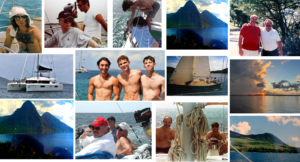
Every summer, my friends and I rented a sailboat and sailed it ourselves with our sons. This isn't as crazy as it sounds: our captain, William Frank, had an impressive sailing resume, and the boys were young, strong, and well-practiced in sailing a yacht. They were also fully engaged, excited by the challenge and the adventure.
The boat, usually a 12-meter monohull sloop, could cruise at about 12 mph in a good wind. That’s not very fast unless you’re tipped over on your side, hanging on for dear life, with green water rushing by inches from your face. Then it feels like you’re in a rocket. It was exhilarating and an endless source of animated conversation; imagine teenagers engaged in animated conversation with their parents.
The adults claimed the boat’s cabins, leaving the boys with the benches, compartments, and holds. Sleeping was difficult in the cramped, hot, and airless accommodations, especially for the boys, who were often soaked by the nightly rain, but we soldiered on; Imagine teenage boys suffering without complaint! Griping was not part of the sailing ethos. Even if you did, no one would listen. After all, we were all in the same boat.
Of course, there were safer, more comfortable boats. For example, we could have rented a glass-enclosed, air-conditioned, gasoline-powered motor yacht. Our captain called these “floating microwaves.” Or we could have rented a catamaran with a galley, living room, lounge, and sun deck—roughly three times the space of a monohull. The problem with the cats was we didn’t have the expertise to heel them safely for racing, and for some reason we wanted speed.
As I said, with good wind, well-trimmed sails, a courageous helmsman, a daring captain, and an indefatigable crew, the boat could be heeled over onto its side and reach a blazing 12 MPH. It was easy to understand why teenagers would find this death-defying maneuver fun, but why their middle-aged, deskbound parents would find it enjoyable or acceptable was a mystery. A lot of unexplained behavior happened at sea.
The day’s sailing was another source of animated nighttime conversation.
Even the boat’s lowly anchor was the subject of intense debate. Was it in the right location? Was it set properly? Was the seabed adequate? Was sand or mud better for anchoring? Would the anchor hold the boat while we slept? How much wind could it handle? This seems silly now, but in a pitch-black night on the water in a foreign country, with no weather forecast, no coast guard, no emergency service, the anchor was our god.
While the boys were growing up, we sailed Italy, New England, and most of the Caribbean from The Bahamas to Grenada. I have no idea how many islands, deserted beaches, ports, and one-bar towns we visited. I don’t know how many nights we cooked on the boat and talked. There was no TV, radio, smartphone, internet, or computer, and little light for reading. All we had was conversation with each other to pass the time… imagine.
Not that it was all fun. During an El Niño summer, we ran into a fierce 60-mph wind off St. Lucia that nearly put us and our $1.5 million boat on the rocks. Then there was the night we encountered headwinds and arrived off an unfamiliar Dominica shore in total, inky darkness, inching our way into the anchorage with flashlights. Once, one of the boys used up all of our fresh water taking a long shower, and we went without for days. Still, we survived.
Sadly, William died in 2017.
My grandsons and I went on several more trips. We had to scale back the adventure some by renting a cat instead of a monohull, by hiring a captain instead of William, and by sailing the calm waters of the BVIs and the Bahamas instead of the wild Grenadines and Dominica. It didn’t matter; the old magic was still there.
The water plays tricks with your mind sometimes, and I often imagined on those grandson trips that it was my son Mike handling the lines rather than his son Mitch. It was understandable: they look and act the same, and the ocean and the islands weren’t any different.
I'm less agile, and I do most of my sailing on cruise ships nowadays. Not that I was ever much of a bareboat sailor. Mike, the other boys, and my grandsons were much better. My fun came from watching them meet the challenge.
Would I recommend it? Absolutely. Sailing is great fun and affordable if you're prepared to rough it a bit. Many sailboats rent for about $1,200 a day, often with a captain and provisions. Try vacationing in an oceanfront resort with six people for $1,200 a day.
Things will go wrong, of course, like running out of water, getting stuck on a sandbar, engine trouble, and worse, but coping is part of the deal.
 Ann Landers said, "At age 20, we worry about what others think of us. At age 40, we don't care what they think of us. At age 60, we discover they haven't been thinking of us at all." I would add that at age 80, we're just happy that we can have concerns about any of this.