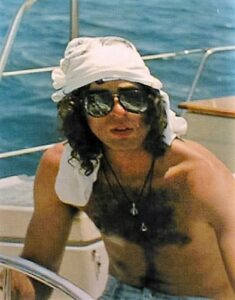
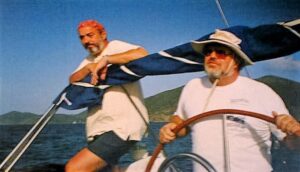
Every summer from 1990 to 2001, my friends and I vacationed together on a rented sailboat with our sons. These one-week rentals were always “men only,” which reduced griping, and “bareboat,” where we crewed the boat ourselves. This isn’t as crazy as it sounds: our captain William Frank had his Coast Guard certification and an impressive sailing resume; the kids were young and strong; and, after a trip or two, experienced enough to help. More importantly, they were engaged, excited about sailing the boat anywhere we wanted, and stunned by the freedom.
 …
…
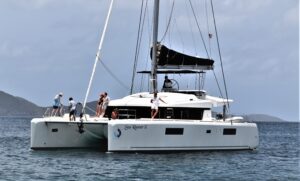
There were few rules aboard ship and few of us willing to enforce the one that remained. The boat (never “the ship”) was usually a 12-meter (40-foot), monohull, sloop (a sailboat with one hull and one mast) that could do 11 knots (12 mph) in a good wind. It had three or four small cabins, which the men used, and several sleeping berths, benches, and two fo’c’sle (forward) compartments. These compartments were more like glass-topped coffins built into the deck, but the kids loved them. That is, until the nighttime rain forced them out, usually to an empty space on the deck. A good night’s sleep was rare for everyone, but there were few complaints. Imagine, teenagers without complaints; griping was simply not part of the shipboard ethos. Anyway, who would they complain to, we were literally all in the same boat.
Of course, there were more comfortable options for going to sea. For example, we could have rented a glass-enclosed, air-conditioned, gas-guzzling motor-yacht, which our captain referred to as a floating microwave — ‘nuf said about this. We could have also rented a catamaran. The 12-meter cats had two hulls, a galley/lounge between the hulls, and flat forward deck space for sunbathing; it also had two or three times more space than a monohull and was therefore considerably more comfortable for sleeping, eating, and hanging about during a long sail. The problem with the cat was that it was hard and dangerous to heel the boat, that is, to lean it over on its side for speed … and we wanted speed. Sailing from place to place is a mind-numbingly boring experience, what made it exciting was racing the boat.
With good wind, well-trimmed sails, a courageous helmsman, and a daring captain and crew, the boat could be heeled onto its side, nearly perpendicular, with its rails in the water. This maneuver raised the hull out of the water for maximum speed. It also forced the crew to hang on for dear life as tons of water passed just inches from us at 18 feet per second. Eleven knots is not very fast, but in a sailboat it feels like a rocket ship. It was exhilarating and the source of endless discussion once the boat was secured for the evening. Again, imagine teenagers engaged in animated discussion about anything with adults.
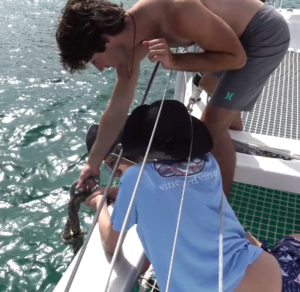
In fact, there were lots of opportunities for teenage engagement — the pure adventure of having no agenda, the non-trival challenge of sailing, learning new and essential shipboard skills, the novelty of a different beach or anchorage or town or ports…. All of it generated deep and long discussion in which everyone — adults and kids — participated. After all, most nights there was nothing else to do but talk to each other. Even the lowly anchor was the source of much discussion and debate — where it had been placed, whether it had set properly, the nature of the seabed it gripped, what seabed was best for anchoring, would it hold the boat while we slept, how much of a wind could it handle, and so on. It all seems trivial now, but in a pitch-black night on the water, the anchor was our god.
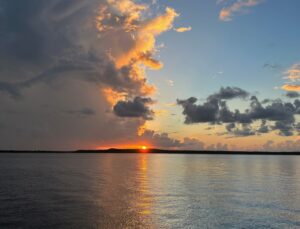
Our trips took us to windy waters off Capri, Cape Cod, the Bahamas, Grenada, the BVI, St Martin, St. Lucia, Nevis, Antigua, Dominica, Anguilla and more, and to exotic ports like Charlotte Amalie (St. Thomas), Philipsburg (St. Maarten), Castries (St. Lucia), St. John’s (Antigua), Fort-de-France (Martinique), and Gaeta (Italy). Each day of the sail, we would race and explore a deserted beach or two, and each evening we would anchor or moor the boat in a different anchorage. If there was a town, restaurant, or bar around, we would all jump into the dingy and motor to shore. (Not many rules regarding minors in remote Caribbean anchorages.) If not, we would cook burgers or local fish on the boat and talk. Again, there were few complaints; it was the wind, the sea, the distance, the weather… that was responsible for our situation, why bother complaining about them?
Not that it was all good. We ran into horrible El Niño weather one year off St. Lucia’s Pitons. It whipped up a 60-mph wind one night that nearly smashed our $1.5 million dollar boat, and us, against the inhospitable shore.

Then there was the sail when we ran into a head wind and arrived in an unfamiliar Dominica anchorage in the inky darkness, inching our way forward with inadequate flashlights. Then there was the trip when a new crewman showered unnoticed long enough to consume all our fresh water, and we spent three days in the tropical heat without showering. Still, we survived it all, and the boys were wiser for the experience.
 Sadly, William died in 2017.
Still convinced, however, that sailing was a great experience for kids, I took my grandsons on several more trips. We had to cut back a little on the adventure by renting a cat instead of a racer, by hiring a captain instead of William, and by sailing the gentle BVI and Bahamas instead of the wild Grenadines and remote Dominica. It hardly mattered though; we had the same great times. Sometimes on those trips, I imagined that it was my son Mike handling the lines rather than his son Mitch.
I’m less agile now, and I do most of my sailing on cruise ships. Not that I was ever much of a bareboat sailor — Mike and the other boys and my grandsons were much better than I and a lot more serious about their shipboard duties.
Would I recommend it? Absolutely. Sailing is a terrific hobby, great fun, and inexpensive, contrary to the common misconception that it’s a rich man’s sport. In fact, it is a relatively inexpensive way to vacation if you’re prepared to rough it a bit. Most sailboats rent for less than $1,200 a day, including a captain and provisions. That’s $200 per day per person with six people sailing. This is a small fraction of what it would cost for a group of six: to vacation at a Caribbean resort in an ocean-facing room; to visit five or six nearby islands; to swim on deserted beaches; and to dine and drink in private and exotic anchorages. Things will go wrong, of course, like running out of water far from any possibility of resupply, getting stuck on a sand bar, losing your engine, and worse, sometimes much worse, but coping with the unexpected is part of the fun. Try it.


 Ann Landers said, "At age 20, we worry about what others think of us. At age 40, we don't care what they think of us. At age 60, we discover they haven't been thinking of us at all." I would add that at age 80, we're just happy that we can have concerns about any of this.