Like my father, I've always been handy—a 2nd-generation do-it-yourselfer who was never afraid to tackle a home fix-it or build-it job. Most of the time, I did okay—never doing anything as well as a professional, but always paying less... and always learning. Over time, this experience gave me truly stupefying and stupidly unwarranted confidence.
Which led to my first real estate purchase: a $65k townhouse condo in Staten Island; my first construction adventure: finishing the basement; and my first encounter with NYC building codes: I used strictly forbidden Romex cable and plastic pipe.
Unfazed by my lack of knowledge, I bought a $125k lakefront vacation home in the Catskills in 1983 and spent countless hours learning how to fix burst copper pipes, adding 1,200 square feet of deck on 8 levels to get down the 50 feet to the lake, constructing a cement lake wall, and building a floating dock that could handle the 15-foot change in water level (turns out, the lake was a heavily used reservoir).
If you're getting the idea that a little knowledge is a dangerous thing, then you're in the right pew.
Confidently, I decided that we needed a bigger place and bought a 4,000-square-foot house nearby for $365k in 1986, which I immediately started to deconstruct and rebuild. This included bravely taking on the primary bathroom (which was unusable for months), skylights (which are still leaking 40 years later), and countless other alterations and improvements.
Once I had the home chaos under control, I decided the ocean would get more family interest than the lake, and I bought a home in Cape Cod in 2001 for $485k. Here, I backed off my DIY inclinations and let pros build a porch, replace the roof, and rebuild the chimney, though I remodeled the kitchen and built a new staircase myself.
Which brings me, at age 60, to the Dominican Republic. Still restless for a bigger, more challenging real-estate adventure, I bought a $325k home in this poor country in 2005 "as an investment." Sitting alone on the balcony and watching the magnificent waves crashing on the shore just yards away inspired me—with absolutely no plan or real understanding—to buy the adjacent land and build oceanfront condos.
This $6 million decision led to 15 years of horrifying setbacks, like the magnificent waves I referenced taking out two of the three 600-foot seawalls we built, the Dominican Navy arresting our construction crew and confiscating our heavy equipment, and relentless stop-work orders because I refused to pay the bribes people demanded. (I eventually paid them.) Thanks to help from several good friends, I managed to finish the project and sell the 18 condos, recovering all the money invested and even earning a 12% return, albeit over a 15-year period.
But even the sobering DR experience didn't sour me on real estate. In fact, surviving it encouraged me to take on the ultimate challenge—the Mt. Everest ascent that every fearless DIY, real-estate overachiever wants to tackle: Manhattan!
So why is Manhattan the ultimate real estate challenge? First, demand: who doesn't want to live in Manhattan? It's a center for culture, finance, medicine, culinary arts... Second, supply: with only 23 square miles of land and 45 square miles of habitable floor space, new construction is hard. Result: Manhattan is ridiculously expensive, with residential square-foot costs TEN TIMES the national median), and it's regulated by everyone. The city, for example, controls rents, evictions, legal proceedings, co-op/condo offerings, building codes, and sales procedures. Buildings, management companies, boards, unions, contractors, and superintendents have their own rules. It's no exaggeration to say the DIYer who hammers a picture hook violates dozens of rules with each blow.
But let's not worry about the details or the risks... why start now?
My first pied-à-terre apartment (I actually had no intention of moving there permanently) was an 891 sf, one-bedroom, 1968 condo on Broadway and 68th Street. It was in a great location, had a magnificent view all the way down Broadway to 59th Street, and boasted an exciting neighborhood—all for a mere $1.07 million with a $3,200 monthly condo fee. The apartment was a learning experience, specifically:
- People get used to their comforts. 891 sf is nothing when you're used to a 4,000-square-foot house, and once the novelty wears off, you won't visit your pied-à-terre unless it's just as comfortable.
- Small things become major annoyances when you can't do anything about them. For example, heat pumps, which are common in Manhattan, are often noisy, and 60-year-old windows often require immense strength to open.
- It costs about 2% to buy a Manhattan apartment (I paid $4k for an attorney, $10k for the mansion tax, $5k for title insurance, $3k for agent incentive), but the cost of selling is about 7-10% (I paid $4k for a lawyer, $72k for agent commissions, $24k for NYS/NYC transfer tax, $2k for condo fees).
- A big part of living in Manhattan is the prestige. Unfortunately, this often leads to absurd building services that cater to fellow-owner egos. For example, our building had a 24/7 concierge in addition to a doorman whose apparent job was to welcome and bid adieu to residents. By my calculation, this requires 21 8-hour shifts and coverage for vacations, sick days, etc., or about six people, each making about $85k. That works out to a friendly-face building expense of more than half a million dollars. Gimme a break!
- Right now, the Upper West Side is very popular, which makes great apartments—the kind needed for a comfortable pied-à-terre—scarce and expensive. For some reason, there's more supply on the Upper East Side, and they're cheaper.
- Condos, where people own their apartment and share building facilities, are more expensive than co-ops, where people lease their apartments and own a share of the building.
As you might have guessed, these lessons led me to sell after just 16 months of ownership, which gave me the most critical bit of Manhattan intelligence: DIY selling doesn't work in this complicated, nuanced market. A real estate agent—a good one—is important. My guy, Peter, advised me on what to improve (refinish the floors), how to price the unit, how to sell it, and how to respond to offers, which resulted in a bidding war (good for sellers) and a bona fide offer of $1.31 million—$240k more than we had paid. All these financial details, by the way, are public knowledge, and everyone knows where to find them.
The same advice goes for buying a new apartment—get a good agent. The internet makes the search and evaluation seem straightforward, but there are a thousand important details you simply cannot know without experience. Peter patiently worked with me to sort through hundreds of apartment possibilities, visit a score of likely candidates, narrow the field to three acceptable purchases, and oversee the bidding, working with the seller's agent to get the best price. This help isn't cheap—it's typically about 6% of the purchase cost, split evenly between the buyer's and seller's agents, but these terms can vary. (Don't get confused, like I did, with the new NYC rules that let buyers negotiate a commission percentage with their agent and supplement the normal 50-50 split themselves.)
So, we now come to the present, where I am "renovating" my new UES fixer-upper. First, some basic facts about what I bought:
- It's a 2-bedroom, 2-bath, 1,200 sf co-op on 2nd Ave and 79th Street that cost $1.170 million with a maintenance fee of $2,440 (and no concierge!).
- The location is terrific with lots of shopping, restaurants, buses, subways, museums, parks, parking garages, FDR access, etc.
- The view is excellent, but not as great as the one we had on Broadway.
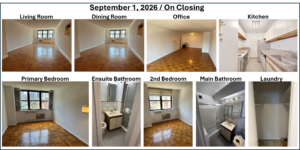
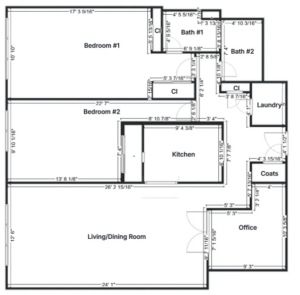
- The apartment's kitchen and both baths are crap and need renovating. I also want to add an office and a washer/dryer to make resale easier.
Here are some pictures that give you an idea of what I bought and what I'm planning:
Here's the floor plan after the renovation
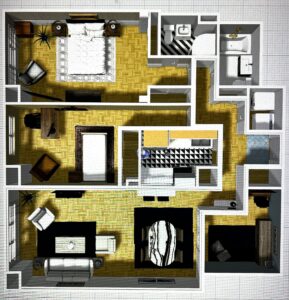
Here's a model with furniture once the renovations are finished:
Here's what I've learned so far:
- Co-ops, no matter what they advertise, don't like pied-à-terre owners, as these owners often create special security issues by being transient and frequently loaning out their apartments. These owners may also be noisier, since they use their apartments for celebrations and special occasions, and they buy and sell more often, creating more move-in, move-out, and renovation commotion.
- A co-op building is typically filled with people who are there for the long term and, consequently, think of the building as a neighborhood. Condo owners and renters are often short-term and, consequently, tend to be more standoffish.
- These days, everyone in a co-op seems to have a dog, and no one objects.
- Condo and co-op boards can be tough when it comes to renovations, especially when they involve extensive electrical or plumbing work, but most owners are in favor of a tough board. Imagine water leaking into your apartment from a shoddy plumbing job on the floor above.
- Good contractors (like agents) are hard to find. We asked for four bids on our renovations. One contractor bid $50k, one $205k, one $90k, and one took so long to bid that I told him to forget it. We chose the $90k bid from the contractor who had refinished our UWS floors.
- Turnkey buyers—those who want to move into a finished apartment—know good appliances and materials and pay premium prices for them. This led me to splurge an additional $15k on appliances and $20k on toilets, tiles, sinks, faucets, etc., for a total budget of $125k, a modest amount for a Manhattan luxury renovation.
- Shopping for this stuff yourself, getting it delivered, and storing it are major complications. First, you need someone who knows what works from a decorating and design standpoint. Second, be prepared to pay heavily. Third, prepare for issues. Our new building, for example, requires all delivery people to have insurance, indemnify the building against loss, and comply with schedules and rules for facilities like elevators and hallway rugs.
- This last item isn't as bad as it sounds unless you deal with a discount online reseller like Wayfair, which uses FedEx to ship small items and private truckers to carry big and/or heavy items. To cope, you must become best friends with the super, doormen, and truckers. A discreet, healthy tip usually works wonders as well once you've established some rapport. Get cheap or act badly and you could be dealing with delivery problems forever.
- Which brings us to the big problem of Manhattan apartment renovation: approval, usually requested using an alteration agreement. This document, which takes weeks to assemble, petitions the co-op board to allow alterations. It's hard for a board to refuse your request if they've allowed it in other apartments, but they can make the approval process so onerous you wish you had never started. This is where I am today—I've submitted our plans to the building manager, who has submitted them to the building architect, and we're waiting for his/her approval. When and if we get this, the next step is board approval.

 Ann Landers said, "At age 20, we worry about what others think of us. At age 40, we don't care what they think of us. At age 60, we discover they haven't been thinking of us at all." I would add that at age 80, we're just happy that we can have concerns about any of this.